Trampoline Industry Outlook: Finding Opportunities Amid Challenges
Trampoline industry outlook: why sales slowed, where the margin went, and how buyers and factories adapt through quality, channels and long-term partnerships.

September and October have long been the peak procurement season for trampolines in Europe and North America. Recently, many buyers have sent an unfamiliar message instead: sales are underperforming, inventory is turning slowly, and the expected seasonal boom did not arrive on schedule. This outlook examines why — and where the opportunity sits inside the adjustment, following on from the 2026 trampoline market outlook.
1. Why Sales Slowed: Three Causes
Economic pressure. Inflation and a weaker consumer climate in Europe and the US have squeezed discretionary budgets. A trampoline is a considered purchase, and considered purchases are the ones families delay, trade down on, or skip for a season. Retailers feel that delay directly in slower sell-through.
Homogenisation. Walk a supermarket aisle or scroll a marketplace and most trampolines look the same — similar frames, similar springs, similar photographs. When products are indistinguishable, consumers cannot tell brands apart, retailers are forced into price competition, and loyalty weakens every season. Sameness, not demand, is the deeper problem.
The price war. Low entry barriers keep attracting supply that competes on price alone, often by quietly thinning specifications. Retail prices fall, margins fall further, and the cost reappears later as returns, claims and one-star reviews.
2. Decline or Adjustment? Reading the Cycle
Buyers are divided. Some smaller distributors read the slowdown as a market that has peaked. Others — including partners who have traded through previous downturns — read it as a normal cyclical adjustment that phases out low-quality supply and resets the category on better product. Fifteen years in this industry, across several cycles, supports the second reading: the underlying drivers of demand — family outdoor time, children's activity, home fitness — have not reversed. A correction is not a collapse; it is the phase in which weak ranges and weak suppliers exit, and share moves to whoever used the quiet period well.
3. Where the Margin Went
In a mature market the margin does not disappear; it relocates. It now sits in three places: product differentiation — design, safety systems and materials a competitor's listing cannot copy in a photograph; service excellence — reliability, responsiveness and spare-parts support that keep a retailer's reviews and reorder rate healthy; and supply-chain efficiency — packaging, container loading and delivery timing that decide the real cost per unit. Buyers and factories that negotiate only the unit price are arguing over the one part of the margin that is no longer there.
4. The Channel Shift Underneath
Under the cycle sits a structural change. Traditional OEM volume depended on a small number of very large retail customers; when those customers optimise inventory, shorten order cycles or shift volume to marketplace and private-label models, a factory built on a few giant orders feels it immediately. At the other end, cross-border e-commerce and digitally native brands iterate faster, price aggressively and own the customer relationship. The squeeze is real — but it is a squeeze on undifferentiated volume, not on the category. Suppliers that develop product, support smaller and mid-sized buyers properly, and ship e-commerce-ready packaging are growing inside the same market that is shrinking for pure capacity sellers.
5. What We Are Doing Differently
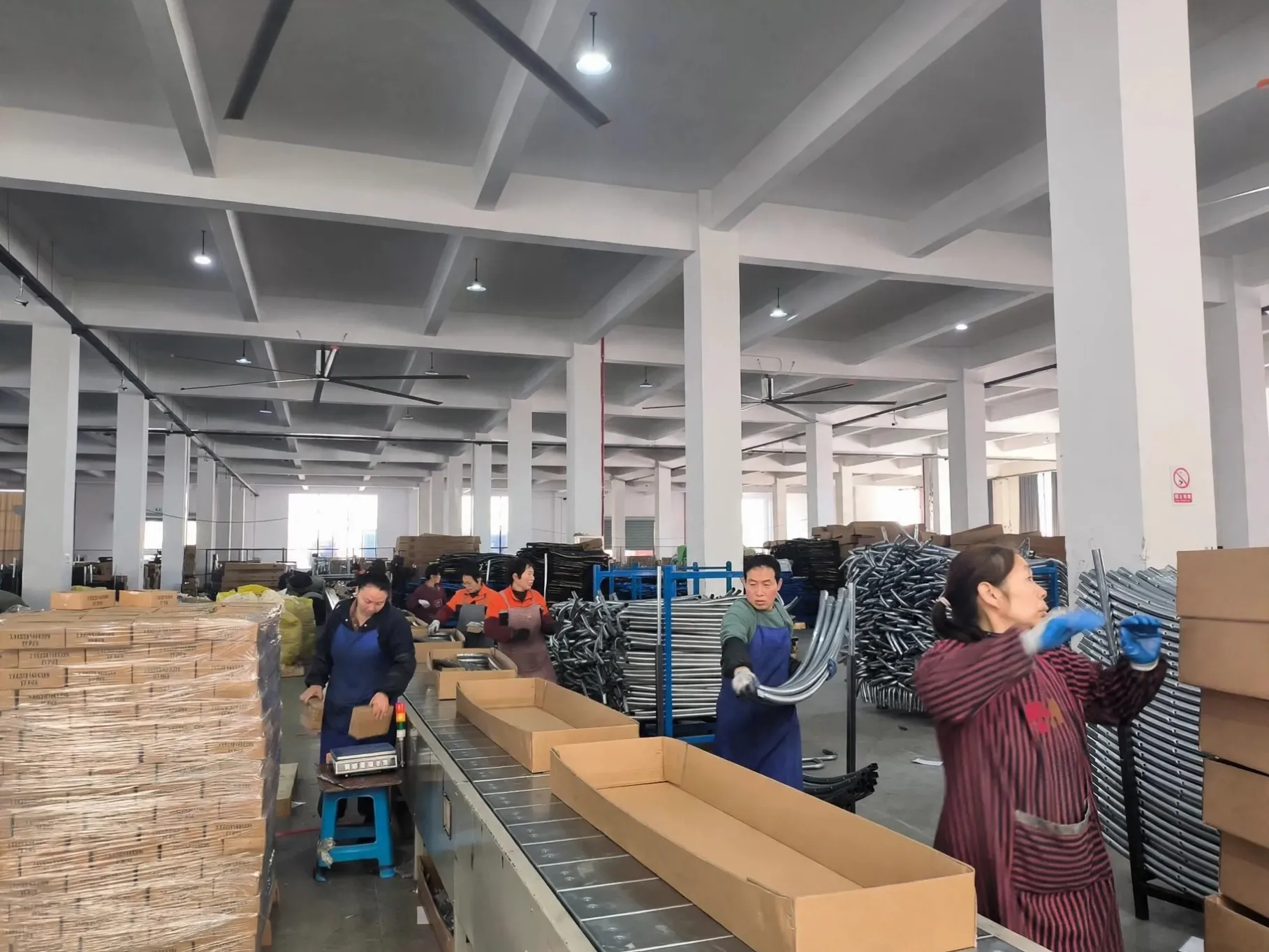
Our response runs on three lines. Product development: space-saving and foldable formats for urban homes, and continued work on durability and assembly speed in the outdoor range — differentiation a buyer can demonstrate, not just describe. Quality discipline: every production run is fully inspected before shipment, covering materials, structure, load performance and compliance documentation for the destination standard. When material prices rise, we cost-engineer around the specification — packaging, loading, process — rather than thinning the steel or the foam, because a trampoline is a safety product and the failure cost lands on the retailer's brand first. Cost optimisation without spec cuts: automated welding, bulk material sourcing and refined assembly reduce cost in ways the end user never feels.

6. Working Through the Cycle Together
When profits tighten, the worst move is to cut communication. The conversations that protect margin are specific: which models are trending or declining in each region; where materials or designs can reduce cost without losing quality; and when to place orders against seasonal price and capacity movements — in our calendar, production runs 15–30 days in the off-season and 40–60 days in the March–July peak, counted from deposit and final artwork confirmation, so timing is a real lever. Formats that diversify a range — including open models such as the trampoline without net for supervised training settings — belong in the same conversation.
Conclusion: Every Bottleneck Is a Sorting Mechanism
The downturn is driven by economic pressure, homogenisation and price competition — a temporary challenge, not an industry collapse. For businesses that adapt, differentiate and hold quality, this is the phase in which share is won cheaply, because weaker players are exiting. The long-term direction of the category has not changed; the winners of the next cycle are being selected in this one.
Read next: Global Kids Trampoline Market: 2024 vs 2031 Outlook · China's Trampoline Industry: Sourcing Insights for Importers