Fitness Rebounders & Mini Trampolines: A Buyer's Product Guide
Fitness rebounders vs kids' mini trampolines: suspension, handlebars, jumping area and load ratings compared, with a B2B sourcing checklist for buyers.
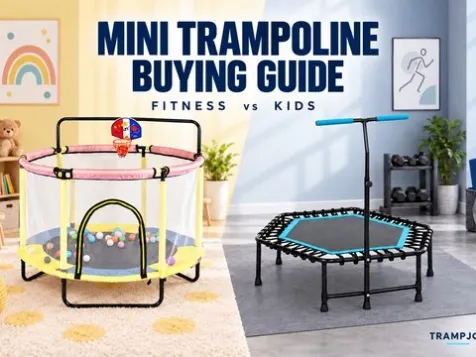
"Mini trampoline" covers two products that should never share a purchase order without thought: fitness rebounders built for adult exercise, and kids' mini trampolines built for age-appropriate play. They share a footprint, a frame and an elastic surface — and almost nothing else. For importers, retailers and private-label brands, the first sourcing question is always the same: who will use it, and where?
1. The Two Categories at a Glance
A fitness rebounder is a low-frame exercise trampoline, typically 36–50 inches, built for cardio, balance and coordination training. Buyers judge it on bounce response, stability, noise and usable jumping area. A kids' mini trampoline is a play product: it may carry a T-bar handle or a full enclosure, and buyers judge it on age suitability, protected contact areas and stability. Adult rebounders are commonly round or hexagonal; kids' models add rectangular and compact enclosure formats. Confusing the two — above all, relabelling a small adult rebounder as a children's product — is the most expensive mistake in this category.
2. Choosing a Fitness Rebounder: Suspension First
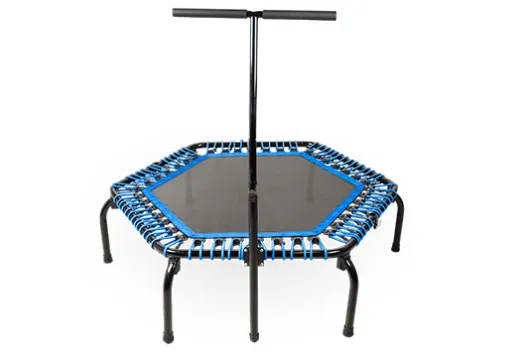
Suspension decides the user experience. Bungee-cord rebounders are chosen for a smoother, quieter, softer-feeling bounce — the apartment and indoor-programme choice. Spring rebounders give a firmer, more responsive bounce, use familiar construction that is easy to inspect spring by spring, and usually win price-sensitive programmes. Neither is automatically better: compare cord or spring specifications, connection design, replacement method and fatigue-test information. On rated capacity, keep the categories straight in your listings: our round spring rebounders are rated at 120 kg, while the hexagonal and round bungee models are rated at 150 kg — and always publish the recommended dynamic user weight, not a one-off static test figure.
Handlebars, jumping area and folding
An adjustable handlebar only adds confidence if the connection is stable: check the number of height settings, the locking method, tube diameter and wall thickness, and whether the assembly moves under repeated dynamic load. Overall diameter is not jumping area — two 40-inch rebounders can feel completely different depending on the suspension zone, so request the effective mat size as well. And "foldable" can mean a folding frame, removable legs only, a detachable handle, or a sectional frame that separates for packing; each version changes assembly time, carton size and container loading, so confirm exactly which parts fold or detach. Our own sectional-frame rebounder takes the last route: the frame separates into sections, which is what makes its carton — and its freight cost per unit — smaller than a one-piece frame of the same size.
3. Choosing a Kids' Mini Trampoline: Age First
Define the age group before anything else, because it drives frame height, jumping area, protective structure, access design, warnings and packaging. Then decide the configuration: a T-bar model is compact and easy to store but needs its handle stability and hard-part distances checked; an enclosure model defines the jumping area and keeps the user on the mat, but its entrance, zipper, pole padding and net-to-mat connection all need inspection. For compact children's products, tipping and sliding resistance usually matter more than a high advertised load figure — review the leg footprint, frame height and anti-slip feet, and test the complete assembled configuration, attachments included.
4. Components Both Categories Share
Whichever side of the category you are buying, verify the same component list. Steel tubing: diameter, wall thickness, surface treatment and tolerance, specified separately for frame, legs, handle tubes and poles. Mat and stitching: material, fabric weight, webbing width and stitch construction — inspect both sides, because reinforcement is not always visible from the top. Suspension: for bungee, cord diameter, count, connection style and replacement method; for springs, length, wire diameter, coating and hook design. Finish and feet: coating matched to the environment, and rubber feet that stay fitted and keep steel edges off the floor.
5. B2B Sourcing Checklist
- State the user (adult fitness or child play) and the environment (indoor, outdoor, studio) in the purchase specification — not just the diameter.
- Get suspension specifications and replacement method in writing.
- Confirm the effective jumping area, not only the overall size.
- Publish the recommended dynamic user weight; keep static test results out of consumer-facing copy.
- For handlebar models, test the locked connection under dynamic load.
- For kids' models, verify age grading, warnings and packaging match the actual design.
- Confirm what folds or detaches, and price the carton and container loading on the real packed size.
Read next: Rebounding Benefits: What Fitness Trampoline Buyers Should Know · Kids Trampolines with Safety Net: A Product Guide for Retailers and Importers