Trampoline Prices Explained: Cost Factors for Importers
Trampoline prices explained for importers: how shape, size, steel, springs, mats, nets, padding and accessories drive factory cost — and how to compare quotes.
Ask ten suppliers for a 12FT trampoline price and you will get ten different numbers — sometimes far apart. The differences are rarely arbitrary. They sit in the shape, the size, and above all in materials and build quality that photographs do not show. This guide breaks down what actually drives a trampoline's factory cost, so importers can compare quotations on substance instead of on diameter and a photo.
1. Shape: Round Is Cheapest to Build
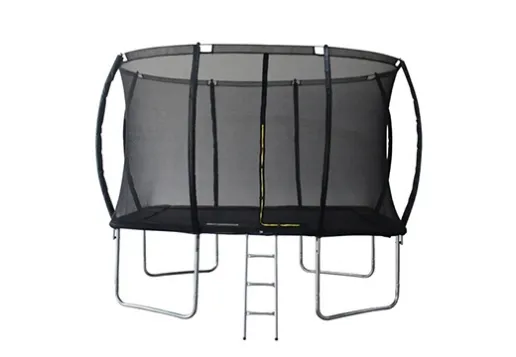
Round trampolines are the most affordable shape: simpler engineering, fewer materials, and an even bounce that suits recreational family use. Rectangular trampolines cost more — complex frame engineering, a stronger support structure and a higher-performance bounce; expect roughly 30–60% more than a comparable round model. Oval trampolines sit between the two, combining a round frame's stability with a longer jumping track at mid-to-high cost. Our 15ft trampoline sits at the large end of the round range, where these shape economics meet maximum size.
2. Size: Every Step Up Costs More Than It Looks
Larger trampolines need more steel, more springs, a bigger mat and net, and — critically for importers — more packing volume. Cost rises with every size step because material content, spring count and shipping volume all increase together. When you compare a 12FT and a 14FT quote, you are comparing the freight per unit as much as the product.
3. Materials and Build Quality: The Hidden Price Factor
Frame steel thickness and coating
Frame material has the largest impact on durability and price. Galvanized steel is the standard; heavier-gauge tube (the old guide's range: 1.2–2.0 mm wall) is stronger and more expensive. Coating method matters as much as thickness — a thin zinc layer and a heavy one look the same in a photo and behave very differently in year three.
Springs: length, quantity and strength
Spring specification varies widely by size (indicatively, a 10FT model may carry 54–72 springs, a 12FT 64–96, a 14FT 72–108). Longer springs and higher counts cost more and change the bounce. When a quote is mysteriously cheap, count the springs and measure the wire.
Jumping mat material
Standard PP mats are affordable; premium UV-resistant mat fabrics raise cost (the old guide estimates 10–20%) and extend service life in high-UV markets. Mat grade is invisible at purchase and obvious after one summer.
Safety net system
Basic PE nets cost least; high-density anti-UV nets cost more; a fiberglass-rod top ring adds stability and price. The enclosure is the part end users touch most — and the part whose failure ends a product's reputation.
Padding and foam
Basic pads (around 10–12 mm foam) are the budget option; premium pads (20–25 mm) protect better and cost more. Pad cover material (PE vs PVC grades) decides whether the pad survives its second winter.
4. Accessories Included in the Box
Quotes differ because boxes differ. A basic set (frame + mat) is cheapest; a standard set adds the net; premium sets add ladder, basketball hoop, weather cover and anchor kit and can run 15–30% higher, with top-ring enclosure systems adding more. Before comparing prices, align the accessory list — a "cheaper" quote that quietly excludes the ladder and anchor kit is not cheaper.
5. Why Some Trampolines Are So Cheap
Unusually low prices are usually explained by some combination of: thinner steel or coating, fewer or shorter springs, lower-grade mat fabric, thinner pads, a basic net, excluded accessories, and lighter packaging that shifts cost into freight damage. None of these is visible in a product photo. All of them are visible in a specification sheet — which is why low-quality and high-quality trampolines are best distinguished on paper before they are distinguished in your warehouse.
6. Reducing Cost Without Losing Quality
Cost can come out of a trampoline without taking quality with it: choose the configuration your market actually needs rather than the maximum specification; align accessory sets with your channel; optimize packaging so freight per unit falls; and consolidate sizes into full containers. What you should not do is fund a lower price from the invisible items in section 3 — that saving returns as warranty claims.
7. In-Ground vs Above-Ground
Above-ground models are the volume market. In-ground trampolines are a premium niche: they require excavation, a retaining structure and special airflow mats, and their installed cost is far above the product price. Importers serving that niche should price the full installed proposition, not the kit.
Read next: Trampoline OEM & ODM Customization: Options for Brands and Importers · Trampoline Procurement Planning: Seasons, Holidays and Peak-Season Stocking