Trampoline Maintenance & Replacement Guide: When to Repair, When to Replace
Trampoline maintenance and replacement guide: inspection points for mats, nets, springs and frames, and how to decide between repair and replacement.
A trampoline rarely fails suddenly. It degrades — UV season by UV season, bounce by bounce — until a worn mat or a brittle net gives way under a jumper. For retailers, installers and facility operators, a clear inspection routine and honest repair-or-replace rules are what keep that from becoming an injury, a claim or a one-star review. This guide covers why the parts age, what to inspect, and where the line between repair and replacement sits.
1. Why Mats and Nets Age First
The jumping mat (woven polypropylene) and the enclosure net (polyethylene) are polymer parts working outdoors. UV radiation breaks down the fibres season by season; rain, frost and temperature swings add stress; and every landing loads the mat's edge stitching and V-rings. As a planning figure, a mat typically serves around 3–5 seasons and a net around 2–3, depending heavily on climate and use — high-UV and coastal markets sit at the short end. The frame and springs last longer, which is exactly why the soft parts need scheduled attention rather than waiting for visible failure.
2. The Inspection Routine
Run this check monthly in season and in full before the first use of spring:
- Mat surface. Rub a hand firmly across the mat. A dark, powdery residue on the skin means the surface fibres are disintegrating — the mat is at end of life. Hold the mat up to the light: pinpricks of light through the weave tell the same story.
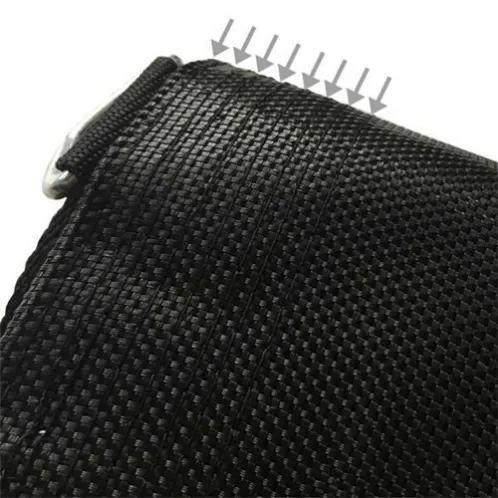
- Stitching and V-rings. The highest-stress area on the trampoline. Fraying or popped stitches around the V-rings, or bent rings, mean the mat's load path is compromised.
- Net. Faded, cloudy or grey patches signal embrittlement. Pinch and pull a small section: if fibres crunch or snap, the net will not hold a falling body. Check the zip and buckles work, every time.
- Sag. A mat that stays bowl-shaped at rest has overstretched; the jumper will bottom out toward the frame.
- Holes. Any hole is a stress concentrator. A small hole in mid-mat may be monitored briefly; a hole near the edge stitching ends the discussion — replace.
- Springs and pads. Gaps between coils at rest mean a spring has overstretched; rust bleeding onto the mat means corrosion is active. Pad foam that no longer rebounds no longer protects.
- Frame. Look for rust at joints and welds, and any deformation — a frame that is no longer true will load everything else unevenly.
3. Repair or Replace? The Decision Rules
- Replace the mat when there is surface flaking, edge-stitching failure, sag, or any hole near the border. Patch kits do not restore a load-bearing edge — do not sell them as a safety repair.
- Replace the net when fibres are brittle, the mesh is torn, or the entry closure no longer shuts reliably. A torn net means the trampoline is out of use until replaced.
- Replace springs in sets when several are stretched or corroded; one new spring among tired ones unbalances the bounce. Never use a trampoline with missing springs.
- Frame surface rust can be cleaned back and protected early; rust that has thinned tube walls, cracked welds or bent the frame is retirement, not repair.
- Replace pads when the foam has collapsed or the cover has split — the pad is a safety part, not trim.
4. Slowing the Wear
Most of the ageing above is UV and weather, and much of it is optional. A weather cover over the mat and net when the trampoline is idle — our trampoline protective cover exists for exactly this — takes the UV load off the fibres between sessions. In snowy regions, remove the mat and net for winter or keep snow load off them; in coastal areas, rinse salt from mat and net monthly. Clean with mild soap and water only — harsh chemicals and pressure washers strip the very protection you are trying to preserve. And keep shoes off the mat: sole grit and friction abrade the weave.
5. What This Means for Your After-Sales
Every trampoline you sell will need a net, a mat or springs within its life. Stock the wear parts for the models you carry, print the inspection routine in the manual, and make the replacement path easy to find on your product pages. Retailers who treat maintenance as part of the product see fewer emergency complaints — and a spare-parts customer who comes back every two seasons is a repeat customer, not a problem.
Read next: Trampoline Installation Guide: Step-by-Step Assembly for Retailers and Installers · Trampoline Parts Replacement Guide: Measuring, Matching and Fitting